Why a shared inbox and a CRM don't filter junk on their own, and what to put in front of sales so they only see real conversations.
A sales rep opens HubSpot Conversations on Monday morning. Mixed in with two inbound demos: a guest-post pitch, a "we can get you to #1 on Google" offer, and a form submission that already created a contact. Nobody assigned those threads to sales on purpose - they just arrived, because nothing stopped them before they hit the queue.
Here's the short version: HubSpot's Shared Inbox is a delivery surface, not a quality filter. Conversations don't score message content before a thread is assigned. Deny lists only catch senders you've already seen. Workflows don't enroll on subject or body without Ops Hub custom code talking to the Conversations API. Spam that lands in the inbox still creates contacts, still sits in the same queue as real leads, and still gets picked up by whoever is next in the rotation.
Why HubSpot doesn't stop inbound noise by default
Shared Inbox is built to capture everything that arrives on a connected channel. That's the point of a team inbox: no message should disappear because it landed in one person's Outlook. The tradeoff is that "captured" and "worth a salesperson's time" are two different problems, and HubSpot only solves the first one out of the box.
What the platform does give you:
- An allow/deny list on the Conversations channel, keyed to email addresses and domains you already know.
- Mark as spam on a thread, which is a one-thread action - it doesn't automatically add the sender to the deny list.
- Conversation-based workflows, which can close or route threads using conversation and ticket properties, not the body of the message.
- Automatic contact creation from logged inbound email, which is useful for real leads and expensive for junk.
What it does not do:
- Score the content of a new message before it appears in the team queue.
- Filter Conversations by subject line or body text as a first-class condition.
- Stop a rotating From address from creating a new contact every time the same pitch arrives from a new domain.
- Keep a junk contact off a sequence enrollment list just because the original thread was spam.
That last gap is where operational noise stops being an inbox problem and becomes a CRM problem. A fake lead that gets created as a contact can match a list, enter a workflow, and get enrolled in a sequence - at which point sales isn't just triaging junk, they're sending from it.
Where this shows up
SEO and guest-post pitches with a new From every time. The most common pattern in HubSpot Shared Inbox. The subject looks vaguely professional. The body is a link-building or "thought leadership" pitch. The sender domain is different from last week's. Deny list doesn't help because there is nothing repeatable to deny.
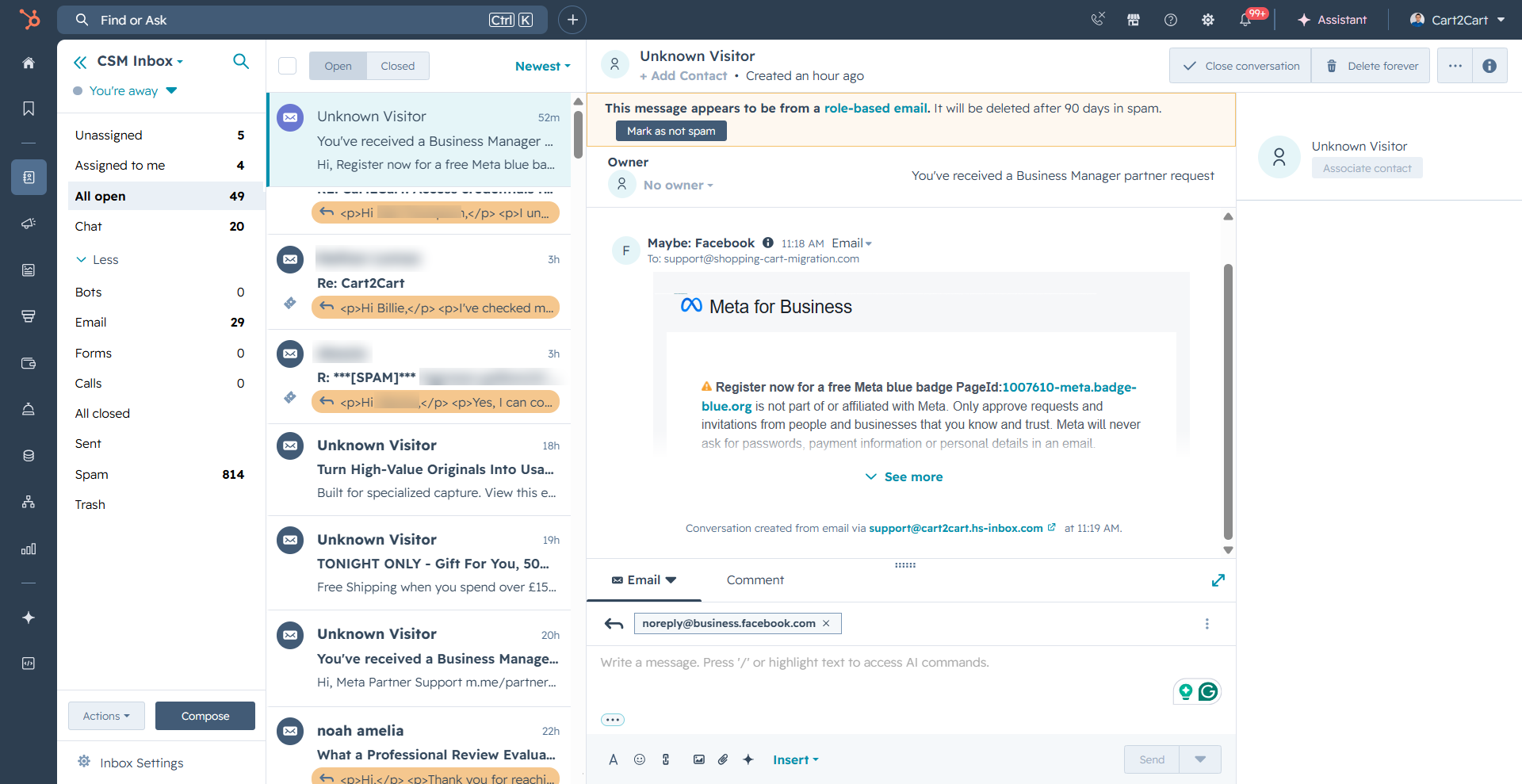
A typical shared inbox before filtering: real conversations sit in the same queue as guest-post pitches and vendor spam.
Form spam that looks like a lead. A bot or a recycled identity submits a demo form. HubSpot does what it's supposed to: create a contact, fire the form workflow, notify sales. The noise isn't waiting in Conversations - it's already in the pipeline.
Sales picking up junk because the queue is first-in, first-out. In a shared inbox, the next available rep takes the next open thread. If a third of new threads are pitches, a third of first-response time is spent dismissing them. That doesn't show up as a lost deal. It shows up as slower speed-to-lead on the threads that actually mattered.
Sequences enrolling contacts that should never have been contacts. A junk submission matches "lifecycle stage = lead" or "form = demo request." If enrollment is tied to that list or that property, the contact gets a multi-step follow-up. The sequence is working. The input is wrong.
Reporting that treats inbound volume as demand. Marketing reports inbound conversations this week. Ops reports new contacts from the website inbox. If a chunk of that volume is operational noise, every conversion rate downstream is diluted - including the ones sales is held to.
What to build
The fix is a filter in front of sales, not a better habit of deleting threads by hand:
- Provider-level quarantine first. Gmail and Microsoft 365 still catch a lot of obvious spam before it ever creates a HubSpot conversation. Subject-based rules for the most repetitive pitches ("guest post," "link exchange") belong there, not in a HubSpot workflow.
- Deny list for repeat senders and domains only. Use it for the agencies and domains that come back. Don't expect it to keep up with rotating From addresses.
- A contact property that marks spam, used as an exclusion everywhere. Something like
spam_filter_status. Every list and workflow that can enroll a contact into a sequence, assign an owner, or create a deal should exclude it. One property, referenced in more than one place, beats a pile of one-off filters. - Whitelist for partners, vendors, and known customers. Filtering inbound is only useful if it doesn't catch the people sales already talks to. Trusted domains should skip scoring entirely.
- Enrollment off events, not off "is a contact." A form fill or a deal-stage change is a moment. "Exists in the CRM and matches a list" is a state that junk can satisfy. This is the same distinction that matters for sequence re-enrollment: enroll from a specific trigger, and unenroll when the situation changes.
None of that requires a new HubSpot seat. It does require treating inbound quality as a CRM input, not as a Conversations housekeeping task.
How Inbox Spam Filter handles this
Inbox Spam Filter is built for the gap HubSpot leaves open: scoring Shared Inbox content after it arrives, before a rep has to read it.
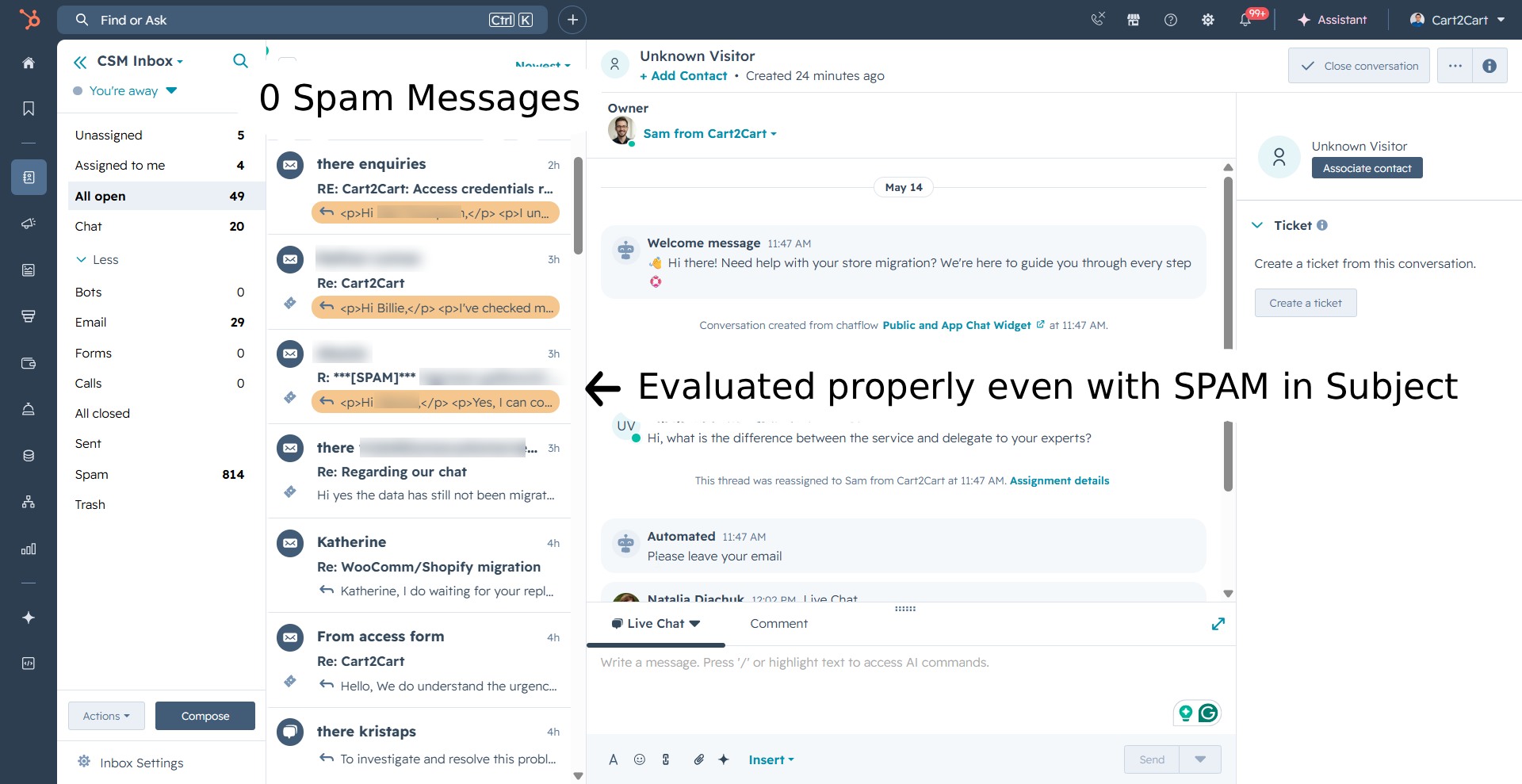
After filtering: spam is flagged in the same shared inbox, so sales isn't triaging pitches by hand.
- Connects to HubSpot Shared Inbox over OAuth and scores new messages with Gemini AI. The default threshold is 70; anything at or above that is treated as spam.
- Every flagged message gets a score and a short reasoning line, so the team can audit why something was filtered instead of guessing at a black box.
- Scoring, whitelist, inbox selection, and notifications are portal-wide - one config for the whole account, not a per-user setup.
- Optionally writes
spam_filter_statuson the related contact, which is the property you use as an exclusion on lists and sequence enrollment workflows. - Custom AI instructions (paid plans) let you describe what "noise" means for your business: guest-post pitches, vendor cold outreach, fake demo requests, and so on.
- A daily digest keeps ops in the loop without making anyone live in the spam log.
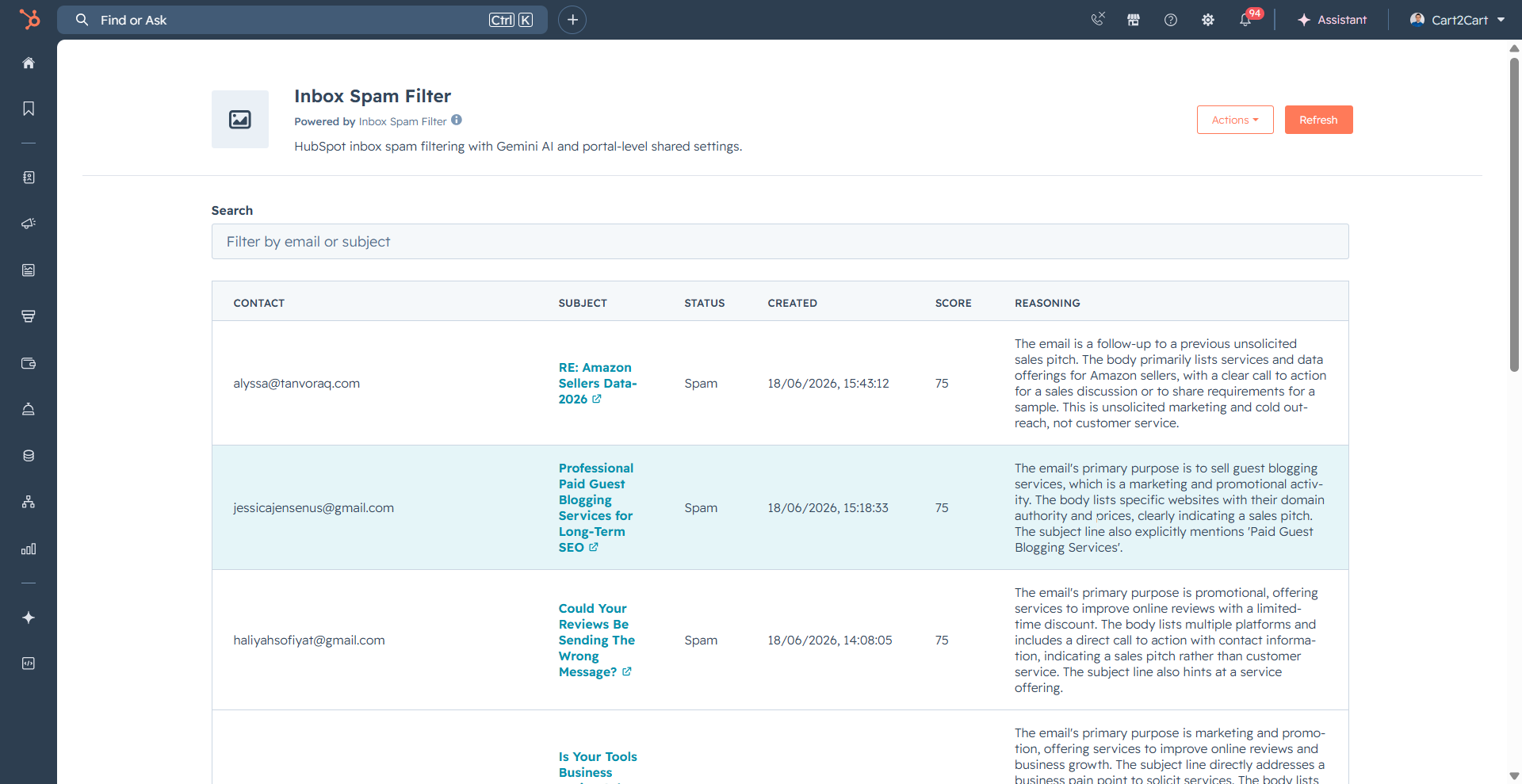
Overview dashboard: each flagged message includes a score and AI reasoning, so ops can audit the filter instead of trusting it blindly.
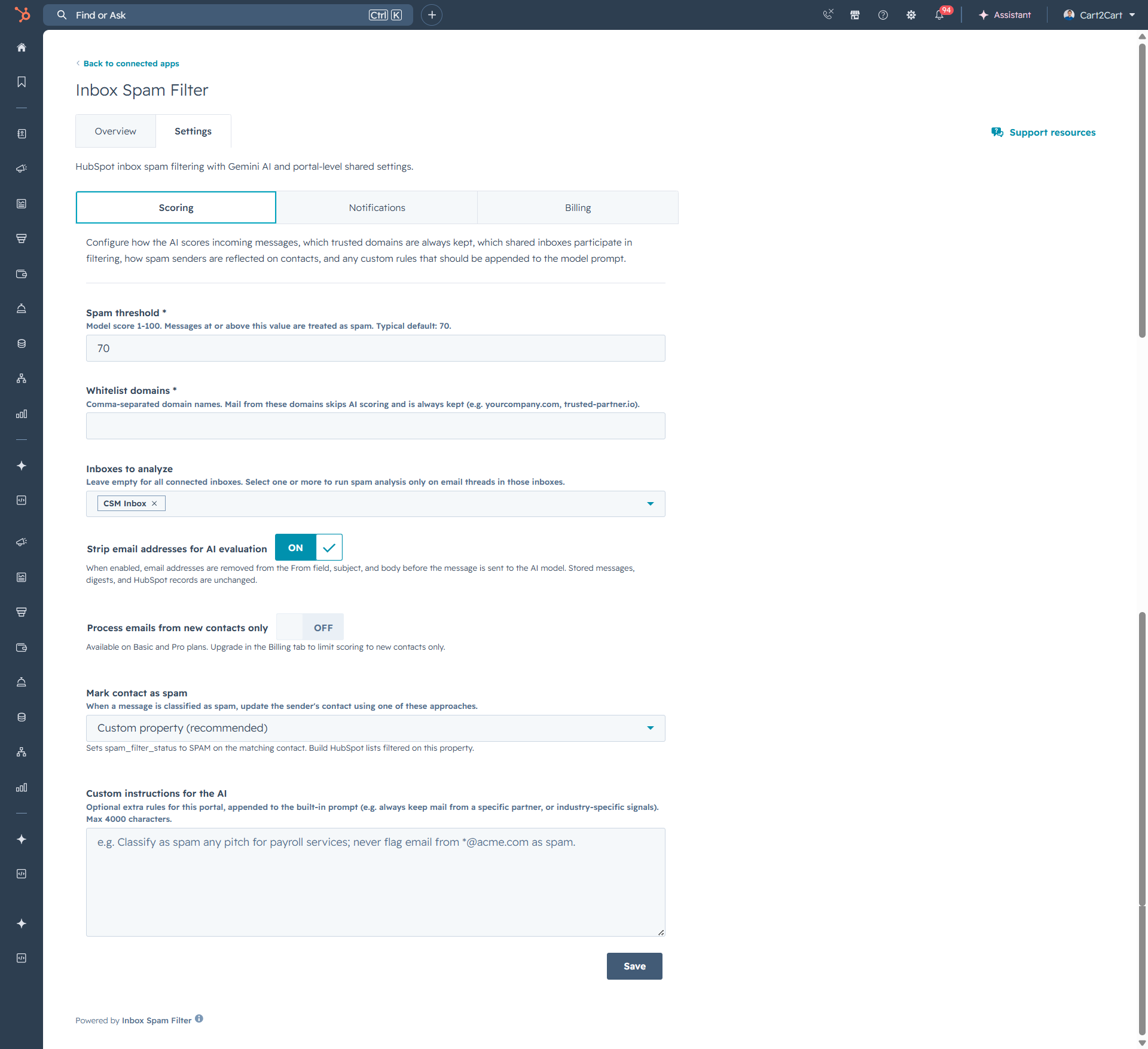
Scoring settings: threshold, whitelist, which inboxes to analyze, and custom instructions - portal-wide, not per user.
Because the filter sits on the inbox, junk doesn't have to reuse the same From address to be caught. Pitches that rewrite every week still read as pitches. That's the difference between a deny list (identity) and a content score (behavior).
It doesn't replace provider quarantine, and it doesn't replace sequence enrollment logic. It sits in the middle: keep the queue clean, tag the contact, and let the rest of HubSpot - including tools like FlowNer - operate on records that were worth creating. Setup details live in the install guide.
Where this meets sequence automation
Once a junk contact exists, HubSpot will treat it like any other contact. If a workflow enrolls "all new leads from the website inbox" into a sequence, the sequence is doing its job. The leak was upstream.
That's why inbound filtering and enrollment/unenrollment belong together:
- Filter noise before it becomes a contact worth sequencing.
- Enroll from a real event (qualified lead, associated deal, manual sales action), not from "appeared in the CRM."
- Unenroll when the situation changes - a deal closes, a contact replies, or
spam_filter_statusflips - instead of letting a sequence run out on a record that never should have been in it.
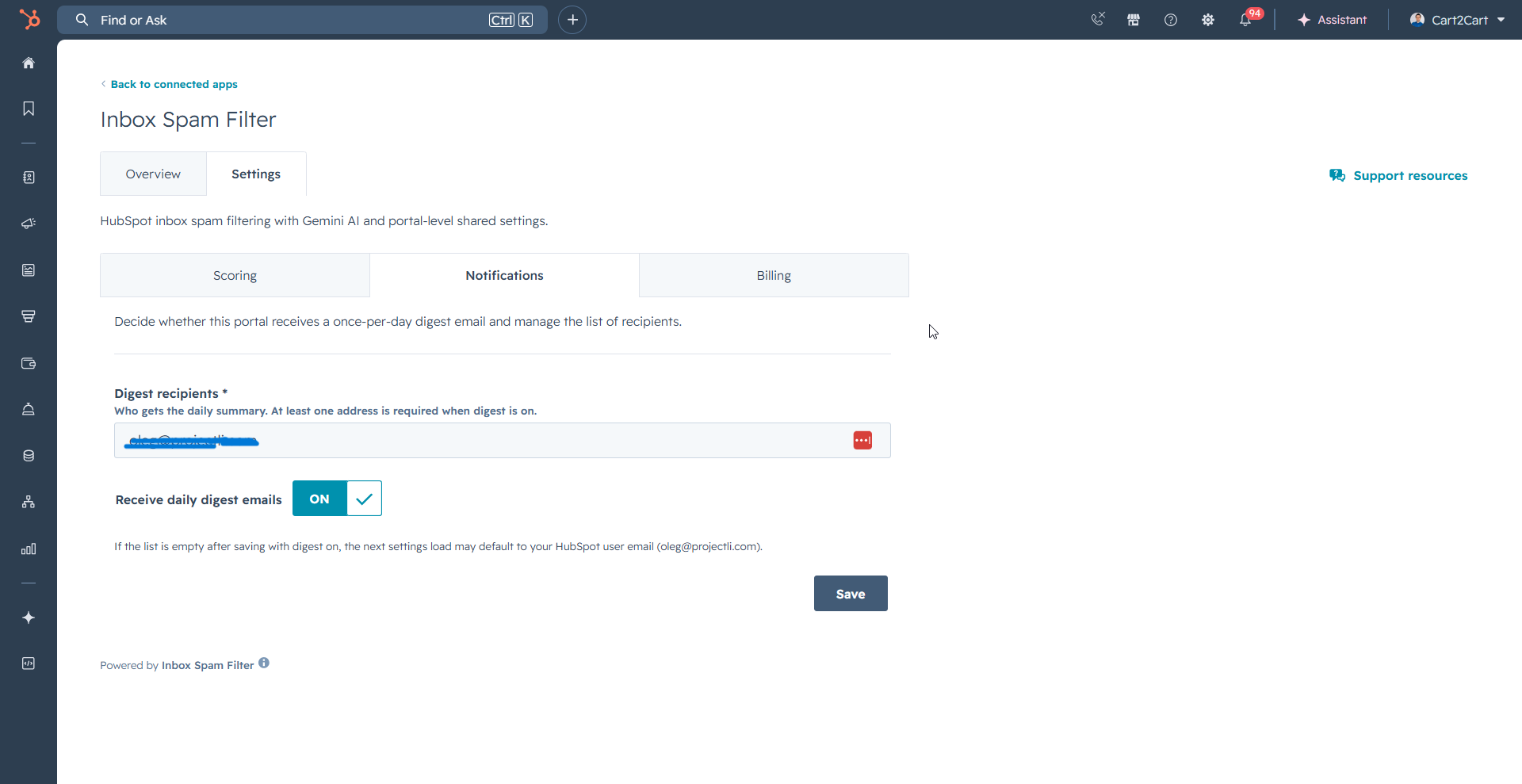
Daily digest: ops can review what got filtered without adding another inbox to the sales team's day.
FlowNer is built for the enroll/unenroll side of that. Inbox Spam Filter is built for the inbound side. Neither one fixes the other problem by itself.
The takeaway
Sales shouldn't be the spam filter. HubSpot will deliver every message the channel receives, create contacts from a lot of them, and happily enroll those contacts into whatever workflow is watching the list. Reducing operational noise means putting a quality check in front of that chain - at the provider, in Conversations, and on the contact record - so sequences, reporting, and reps only see conversations that were worth having.
FAQ
Does HubSpot automatically filter spam in Shared Inbox before sales sees it?
No. Shared Inbox delivers whatever arrives on the connected channel. HubSpot's deny list only blocks senders and domains you've already added, and Mark as spam applies to that thread - it doesn't score content or stop the next pitch from a new address.
Can a HubSpot workflow enroll or close Conversations based on the email body?
Not as a first-class condition. Conversation workflows can use conversation and ticket properties. Reading subject or body usually means Ops Hub custom code plus the Conversations API, which works until the pitches rewrite themselves the following week.
Why does inbound spam create CRM contacts?
Logged inbound email and form submissions can create contacts automatically. That's correct behavior for real leads. For guest-post pitches and fake demo requests, it means the junk isn't just sitting in an inbox - it's already a record that lists, workflows, and sequences can pick up.
What's the difference between a deny list and content scoring?
A deny list is identity: this address, this domain, never again. Content scoring is behavior: this message reads as a pitch, even if the From address is brand new. Most Shared Inbox noise rotates identity on purpose, which is why deny list alone doesn't hold.
How should spam status affect HubSpot sequences?
Treat it as an exclusion, the same way you'd treat an unsubscribe or a closed-won customer. If a contact is marked spam, enrollment workflows shouldn't add them, and an unenroll workflow should pull them out if they're already in a sequence. Otherwise the sequence will keep sending on a record that was never a lead.
Where does Inbox Spam Filter sit relative to FlowNer?
Inbox Spam Filter scores Shared Inbox messages and can tag the related contact. FlowNer automates sequence enrollment and unenrollment. Use the filter so junk never becomes a "lead" worth sequencing; use FlowNer so real contacts are enrolled and unenrolled from events, not from a live list that junk can match.
Guest post by Inbox Spam Filter, a HubSpot Marketplace app for AI spam scoring in Shared Inbox. Available on the HubSpot Marketplace.